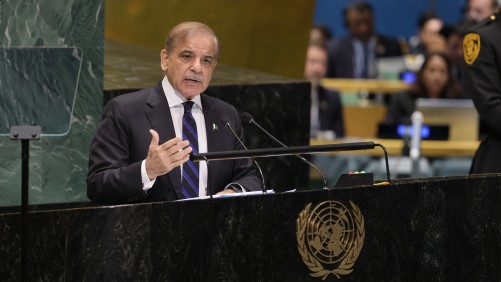
During a crucial session of the United Nations General Assembly, Pakistan Prime Minister Shehbaz Sharif highlighted the significance of former US President Donald Trump’s intervention in the May 2025 conflict between India and Pakistan. Sharif credited Trump’s involvement as pivotal in preventing a potential escalation between the nuclear-armed neighbors, emphasizing the need for South Asia to avoid such precarious situations in the future.
The dispute, which had raised fears of a broader confrontation, saw Pakistan defending its military actions as self-defense under Article 51 of the UN Charter. Sharif praised the country’s armed forces for their response during the conflict, while India maintained that a ceasefire was reached through direct communication with Pakistan, without any third-party mediation.
Sharif’s address also brought attention to the contentious issue of the Indus Waters Treaty, which governs the use of the Indus river system shared by both nations. He criticized India’s decision to hold the 1960 agreement in abeyance, asserting that any attempt to alter Pakistan’s share of the river waters would be considered an “act of war.” The Indus river system is crucial to Pakistan and the surrounding region, and Sharif argued that India’s actions lacked a legal basis, a position he claims is supported by international legal developments.
In response, India accused Pakistan of perpetuating cross-border terrorism and reiterated its stance on defending itself against such threats. India dismissed Pakistan’s allegations and maintained that repeated accusations would not alter its position on the matter.
The ongoing tension over the Indus Waters Treaty underscores the fragile nature of India-Pakistan relations, with water rights being a longstanding and critical issue. The treaty, a cornerstone of bilateral water-sharing since 1960, remains a flashpoint amid broader geopolitical concerns in the region.